Skip to content
Support

Frequently asked questions (FAQs)

Find answers to common questions about GDT by searching our FAQs below.

About GDT Events

GDT (Global Dairy Trade) is the world’s leading dairy trading and price discovery platform.

Through its transparent, rules-based dairy trading platforms and dairy trading insights services, GDT brings together buyers and sellers from more than 80 countries, facilitating approximately US$2–3 billion in trade annually and creating independently established reference prices grounded in genuine market activity.

These trading insights are widely used across the dairy sector to support physical trade, contracting, market analysis and financial risk management.

The strength of GDT’s price discovery is underpinned by its proven methodology, neutral market-based mechanism and participation from the global dairy community. Alongside its trading platforms, GDT provides dairy trading insights that help organisations better understand market movements and make more informed commercial decisions.


Participating in GDT

GDT Trading Events are open to businesses that buy or sell dairy commodity products.

Buyers and sellers must register with GDT, meet the relevant eligibility requirements and enter into the required participation agreements before taking part in Trading Events.

Participation is subject to applicable sanctions requirements. Companies located in countries subject to UN or US sanctions are not eligible to participate, while companies located in non-sanctioned countries cannot nominate sanctioned countries as shipping destinations.

GDT's sanctions framework outlines the requirements that apply to participation in GDT Trading Events and is based on legal advice relevant to all countries where GDT Events operates.

How GDT Trading Events work

The Trading Manager conducts Trading Events on the GDT Events Auction website, where approved bidders bid on the quantity they wish to purchase at announced prices through a series of timed rounds. Each Trading Event lasts approximately two to three hours.

A Trading Event typically follows these steps:

  1. Five days before each Trading Event, the Trading Manager confirms the quantities available and the starting prices for the first bidding round. This information is made available to registered and approved bidders through the GDT Events Auction website.

  2. At the start of the Trading Event, bidders enter the quantities they wish to purchase at the announced starting prices. The Trading Manager closes the first bidding round after a set period.

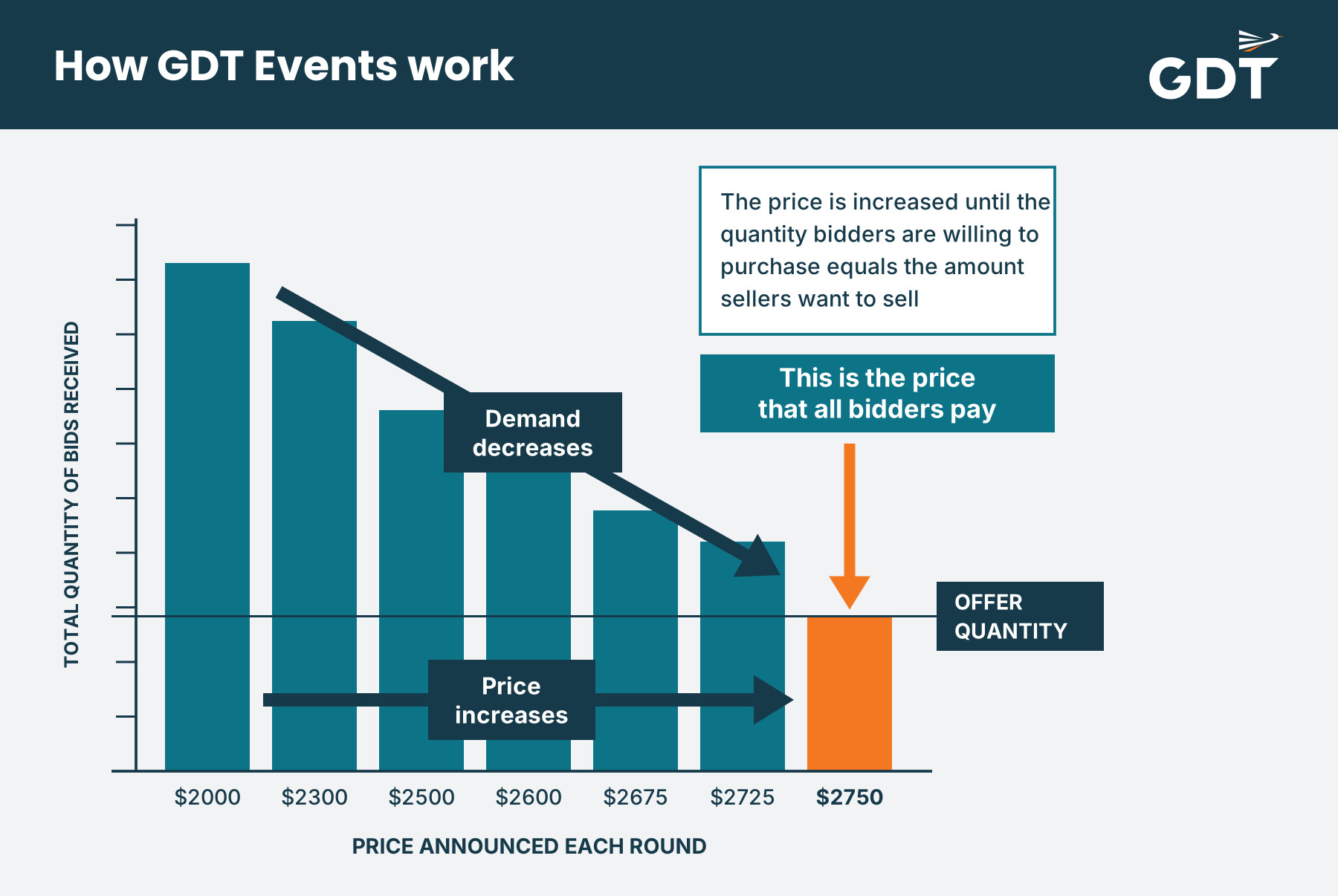
  3. In each subsequent bidding round, where total bids exceed the quantity available, the Trading Manager raises the price and bidders enter revised quantities.

  4. The process continues round by round until the bids no longer exceed the quantity available for purchase, meaning the available quantity has been cleared.

The diagram below illustrates a typical Trading Event (for one product/contract period):
ResizedImage600402-how-GDT-Events-work@3x

Shortly after the Trading Event ends, the Trading Manager confirms the quantities won by each bidder and the final price reached on the GDT Events Auction website.

This final price becomes the winning price paid by successful bidders and the published market price.

Prices and results

GDT prices are determined through an ascending-price clock auction.

During a Trading Event, buyers submit bids at announced prices. Each product starts with a starting price, which is the price offered in the first round. If demand exceeds the quantity available, the price increases and an announced price is set for the next round, allowing buyers to adjust their bids.

This process continues until the auction closes and a winning price is established. Where bidding demand is sufficient to cause the announced price to increase from the starting price, the price is considered market-determined.

If a product is sold at its starting price and is not market-determined, GDT does not publicly disclose the price to keep the seller’s starting price confidential. This can occur when demand for the product is lower than the maximum quantity offered by the seller or when only part of the quantity offered is sold.

Governance

GDT ensures fair and transparent trading through a governance framework built around independence, neutrality and transparency.

The GDT Trading Event Rules set out how GDT Events operate, while the GDT Events Oversight Board represents the interests of participants trading on the GDT Events platform and provides oversight of its operations.

GDT Events operations are monitored by the Board and subject to independent external audit. The Board comprises three GDT bidder-members and three GDT seller members, alongside three financial market members who reflect the role of GDT prices in the NZX dairy derivatives market.

The Board reviews proposed changes to the GDT Trading Event Rules and ensures the operation of the trading platform is consistent with its guiding principles.

In the event of alleged breaches of the rules by participants or their affiliates, the GDT Complaints Ruling Panel reviews complaints submitted for consideration.

Definitions

GDT results use a range of terms to help participants better understand Trading Event outcomes:

  • Quantity sold refers to the total quantity sold across all products, contract periods and sellers in a Trading Event.
  • Minimum supply and maximum supply represent the lower and upper limits of the quantities sellers wish to offer during a Trading Event. Maximum supply may also be referred to as the seller’s offer quantity.
  • The number of participating bidders refers to the number of bidders who entered a bid in the first round of a Trading Event.
  • Average winning price is the quantity-weighted average of winning prices achieved during a Trading Event.

In GDT results:

  • ‘–’ indicates that a product was not offered.
  • ‘n.s.’ (not sold) indicates that no product was sold.
  • ‘n.p.’ (not published) indicates that a winning price was assessed as non-market determined and therefore was not published.
  • ‘n.a.’ indicates that no applicable price or calculation was available for that product or contract period.
  • Location abbreviations: NZ (New Zealand), AU (Australia), BE (Belgium), US (United States), IE (Ireland), EU (Europe), DE (Germany), SE (Sweden), UK (United Kingdom) and DK (Denmark)