How does GDT's ascending-price clock auction work?
Ascending-price clock auctions bring buyers and sellers together in a competitive bidding process, where supply and demand determine final prices that serve as reference points for the wider dairy industry
By GDT ·
From allocating radio spectrum and electricity resources to trading commodities, ascending-price clock auctions are used in a range of different markets. But the basic idea, regardless of what is being bought or sold, stays the same: prices rise as long as demand exceeds the available supply.
Over decades, economists and auction designers have refined various formats, including the clock auctions used today. Grounded in economic theory, a clock auction requires participants to commit to their stated offers and bids, while creating incentives for buyers to reveal their real demand for the products on offer.
With multiple bidding rounds, bidders can adjust their demand as prices change, rather than relying on a black-box to translate their bids into winning allocations and prices. This transparency helps build trust in the auction process and gives bidders a sense of how prices are developing as they adjust their bids.
The competitive bidding process brings supply and demand together to determine auction outcomes and prices, helping ensure products are allocated to buyers who value them most.
GDT (Global Dairy Trade) applies this ascending-price clock auction format through GDT Trading Events and GDT Pulse auctions, facilitating the trade of dairy commodities between dairy buyers and producers from around the world.
What is an ascending-price clock auction?
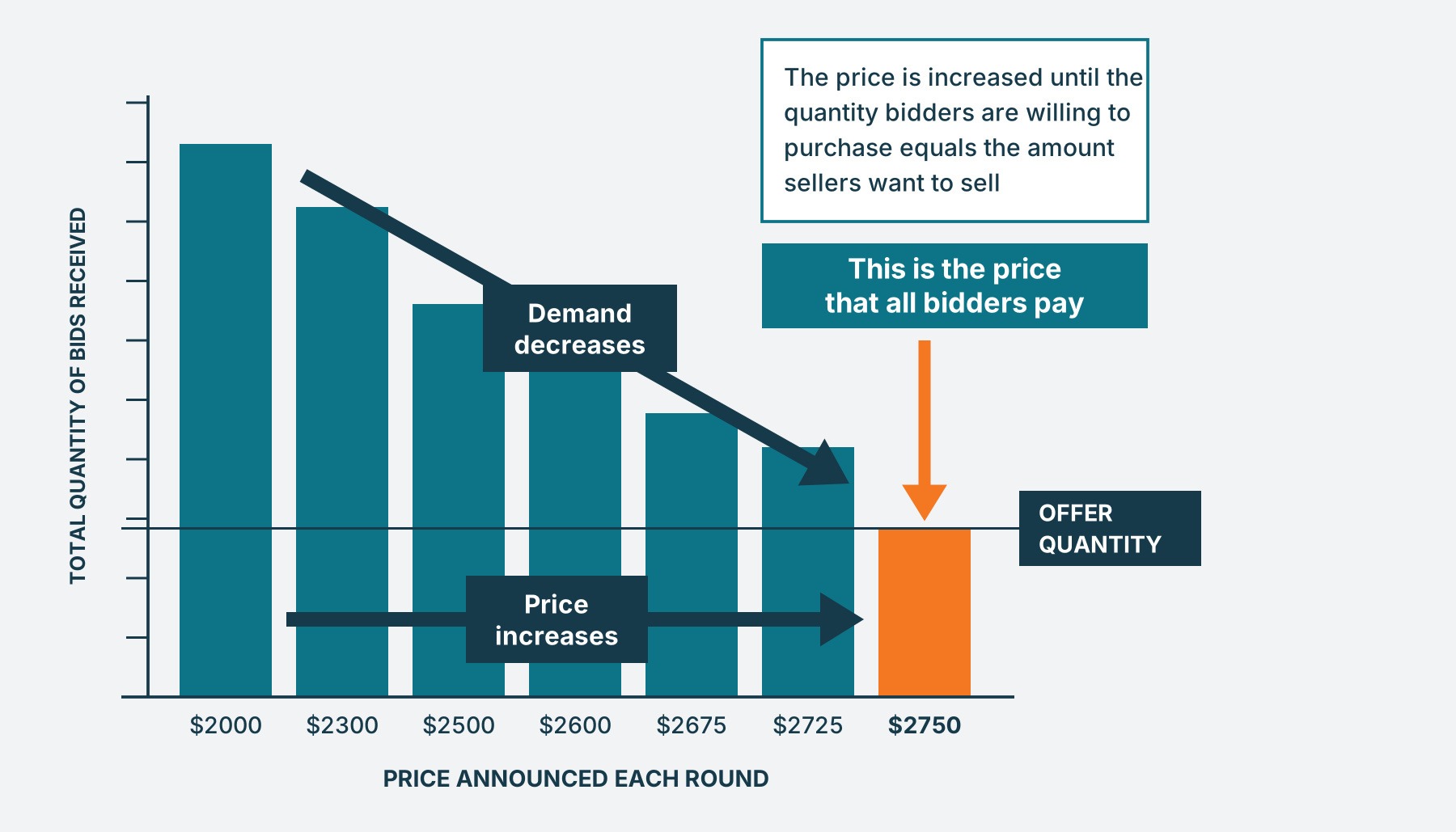
An ascending-price clock auction is a multi-round auction format in which prices increase in each round until buyer demand is at or below the supply available from sellers. At this point, there is no excess demand and the final clearing prices are established.
Throughout the auction, all bidders can see the announced prices in each round. If demand exceeds the available supply of a product, its price increases in the next round, and buyers can adjust their demand in response.
What happens during a GDT Trading Event?
Each GDT Trading Event follows a structured process that can be broken down into the following stages:
1) Sellers announce Trading Event details
Before each Trading Event, sellers announce details of their offering, including the products and quantities available and their starting prices, across up to six contract periods.
2) Buyers submit bids
During each round of the Trading Event, buyers place bids for the quantity they want to purchase at the announced price in that round for each product and contract period.
3) Prices adjust based on demand
At the end of each bidding round, buyer demand is compared with the available supply for each product. If demand exceeds supply, the price increases and the auction moves into another bidding round. This process continues until demand matches the quantity on offer.
4) A final market price is established
Once demand and supply are balanced, the auction closes. All successful buyers pay the final winning price for the same product specification, with the results providing a transparent reference prices for the wider dairy industry.
How auction outcomes inform the market
The outcome of each auction provides a snapshot of supply, demand and prices at that point in time, based on actual bidding activity.
For buyers, sellers, analysts, commodity traders, financial institutions and other industry participants, the resulting prices provide a common reference point for tracking price movements and informing decisions across the dairy industry.